The Art Students League of New York Lobby Phone Booth
| John Sloan | |
|---|---|
 Sloan in 1891 | |
| Born | John French Sloan (1871-08-02)August 2, 1871 Lock Haven, Pennsylvania |
| Died | September vii, 1951(1951-09-07) (anile eighty) Hanover, New Hampshire |
| Nationality | American |
| Educational activity | Pennsylvania Academy of the Fine Arts |
| Known for | Painting, Etching |
| Notable work | McSorley's Bar, (1912), Sixth Avenue Elevated at Third Street, (1928), Wake of the Ferry, (1907), and Hairdresser'due south Window, (1907) |
| Movement | Ashcan School |
| Awards | Gold Medal (1950) |
John French Sloan (Baronial two, 1871 – September 7, 1951) was an American painter and etcher. He is considered to be one of the founders of the Ashcan school of American art. He was as well a member of the grouping known as The 8. He is best known for his urban genre scenes and ability to capture the essence of neighborhood life in New York City, oftentimes observed through his Chelsea studio window. Sloan has been called the premier artist of the Ashcan School, and too a realist painter who embraced the principles of Socialism, though he himself disassociated his art from his politics.
Biography [edit]
John Sloan was built-in in Lock Haven, Pennsylvania, on August 2, 1871, to James Dixon Sloan, a man with artistic leanings who made an unsteady income in a succession of jobs, and Henrietta Ireland Sloan, a schoolteacher from an flush family unit.[1] Sloan grew up in Philadelphia, Pennsylvania, where he lived and worked until 1904, when he moved to New York City.[two] He and his two sisters (Elizabeth and Marianna) were encouraged to describe and paint from an early age. In the autumn of 1884 he enrolled at the prestigious Key High School in Philadelphia, where his classmates included William Glackens and Albert C. Barnes.[iii]
In the spring of 1888, his male parent experienced a mental breakdown that left him unable to work, and Sloan became responsible, at the age of 16, for the support of his parents and sisters. He dropped out of school in order to work full-fourth dimension equally an assistant cashier at Porter and Coates, a bookstore and seller of fine prints.[4] His duties were light, allowing him many hours to read the books and examine the works in the shop's print department. It was there that Sloan created his earliest surviving works, amongst which are pen-and-ink copies after Dürer and Rembrandt. He as well began making etchings, which were sold in the store for a modest sum. In 1890, the offer of a higher salary persuaded Sloan to leave his position to work for A. Edward Newton, a former clerk for Porter and Coates who had opened his own stationery store. At Newton's, Sloan designed greeting cards and calendars and continued to piece of work on his etchings. In that same year he likewise attended a night drawing class at the Spring Garden Institute, which provided him his start formal art preparation.[5]
He soon left Newton'southward business in quest of greater freedom as a freelance commercial artist, merely this venture produced little income. In 1892, he began working as an illustrator in the fine art department of The Philadelphia Inquirer. Afterwards that same yr, Sloan began taking evening classes at the Pennsylvania Academy of the Fine Arts nether the guidance of the realist Thomas Anshutz.[half-dozen] Among his beau students was his old schoolmate William Glackens.
In 1892, Sloan met Robert Henri, a talented painter and charismatic advocate of artistic independence who became his mentor and closest friend. Henri encouraged Sloan in his graphic work and eventually convinced him to plow to painting. They shared a mutual artistic outlook and in the coming years promoted a new form of realism, known as the "Ashcan school" of American art.[7] In 1893, Sloan and Henri founded the curt-lived Charcoal Club together, whose members would besides include Glackens, George Luks, and Everett Shinn.[4]
Towards the stop of 1895, Sloan decided to get out The Philadelphia Inquirer to work in the art department of The Philadelphia Press. His schedule was at present less rigid, allowing him more time to paint. Henri offered encouragement and oft sent Sloan reproductions of European artists, such as Manet, Hals, Goya and Velázquez.[6]
In 1898, the socially awkward Sloan was introduced to Anna Maria (Dolly) Wall (born July 28, 1876), and the two fell immediately in honey. In entering into a relationship with her, Sloan accepted the challenges posed past her alcoholism and her sexual history, which included prostitution; although Dolly worked in a department store past twenty-four hour period, Sloan had, in fact, met her in a brothel.[viii] They were married on August 5, 1901, providing Sloan with an affectionate partner who believed in him absolutely, only whose lapses and mental instability led to frequent crises. A particularly shut friend in their New York years, who helped the couple to weather many of these crises, was the creative person John Butler Yeats, the elderly father of poet William Butler Yeats.

Past 1903, Sloan had produced near sixty oil paintings only had even so to establish a proper noun for himself in the art world.[6] In April 1904, he and Dolly moved to New York City and institute quarters in Greenwich Village where he painted some of his all-time-known works, including McSorley'south Bar, Sixth Avenue Elevated at Tertiary Street, and Wake of the Ferry. He became increasingly prolific, but he sold little, and he continued to rely on his earnings as a freelancer for The Philadelphia Press, for which he continued to draw weekly puzzles until 1910. Past 1905, he was supplementing this income by cartoon illustrations for books (including Wilkie Collins' The Moonstone)[ix] and for such journals every bit Collier's Weekly, Good Housekeeping, Harper's Weekly, The Saturday Evening Post, and Scribner'south.[10] Sloan participated in the landmark 1908 exhibition at the Macbeth Galleries of a grouping that included four other artists from the Philadelphia Charcoal Society (Henri, Glackens, Luks and Shinn) as well as iii artists who worked in a less realistic, more than impressionistic mode, Maurice Prendergast, Ernest Lawson, and Arthur B. Davies. The group was afterward collectively known every bit "The Eight."[four] The Macbeth Galleries exhibition was intended every bit a rebuke to the restrictive exhibition practices of the powerful, conservative National Academy of Blueprint. Sloan organized a touring exhibition of the paintings from that bear witness that traveled to several cities from Newark to Chicago and elicited considerable discussion in the press about less academic approaches to art and new definitions of adequate subject matter.
A doctor who was consulted in an effort to aid Dolly overcome her drinking problem suggested a scheme to Sloan: he was to start a diary in which he would include his fondest thoughts of her, with the expectation that she would surreptitiously read it and be freed of her disabling fear that Sloan would leave her. Spanning the catamenia from 1906 to early 1913, the diary shortly grew beyond its initial purpose, and its publication in 1965 supplied researchers with a detailed chronicle of Sloan's activities and interests and a portrait of the pre-war art world.[11]
Sloan's growing discontent with what he chosen "the Plutocracy's government"[12] led him to join the Socialist Party in 1910.[13] Dolly Sloan also became active in Socialist projects at this time. John Sloan became the art editor of The Masses with the Dec 1912 outcome[14] and contributed powerful anti-war and anti-backer drawings to other socialist publications every bit well, such as the Call and Coming Nation. As Sloan was never entirely comfortable with propaganda, his piece of work for these magazines did non always incorporate overt political content. His conventionalities that "The Masses" was condign too doctrinaire led to a dispute with boyfriend editors Max Eastman and Floyd Dell, causing him to resign his position with that periodical in 1916. He was never an ally of the Communist Party in the Usa, although he remained hopeful that the Soviet Union would succeed in creating an egalitarian society.[15] Throughout his life, he identified with left-wing political causes and expressed vehement disapproval of the inequities of the American economic organisation. A pacifist, he besides opposed the American entry into World War I.
In 1913, Sloan painted a 2-hundred-foot properties for the Paterson Strike Pageant, a controversial piece of work of performance fine art and radical politics organized past activist John Reed and philanthropist Mabel Contrivance. The play, a benefit staged for the hitting silk mill workers of Paterson, New Jersey, took place in Madison Square Garden and incorporated over 1,000 participants. Sloan has been called "the premier artist of the Ashcan School who painted the inexhaustible energy and life of New York City during the commencement decades of the twentieth century".[16]
Also in 1913, Sloan participated in the legendary Armory Show. He served every bit a fellow member of the organizing committee and likewise exhibited two paintings and five etchings.[17] In that same year, the important collector Albert C. Barnes purchased one of Sloan's paintings; this was but the fourth auction of a painting for Sloan (although it has often erroneously been counted every bit his first).[18] For Sloan, exposure to the European modernist works on view in the Armory Evidence initiated a gradual movement away from the realist urban themes he had been painting for the previous ten years.[19] In 1914–15, during summers spent in Gloucester, Massachusetts, he painted landscapes en plein air in a new, more fluid and colorful manner influenced by Van Gogh and the Fauves.[xx]

Beginning in 1914, Sloan taught at the Art Students League, where for the side by side eighteen years he became a charismatic if eccentric teacher. Sloan as well taught briefly at the George Luks Fine art School. His students respected him for his practical knowledge and integrity, but feared his caustic tongue; as a well-known painter who had still sold very few paintings, he advised his students, "I have nothing to teach you that will help you to brand a living."[21] He disdained careerism among artists and urged his pupils to find joy in the creative process solitary.
The summer of 1918 was the last he spent in Gloucester. For the next 30 years, he spent 4 months each summertime in Santa Iron, New Mexico, where the desert landscape inspired a new concentration on the rendering of form. Withal, the bulk of his works were completed in New York.[22] As a result of his fourth dimension in the Southwest, he and Dolly developed a strong interest in Native American arts and ceremonies and, back in New York, became advocates of Indian artists.[23] In 1922 he organized an exhibition of work by Native American artists at the Society of Contained Artists in New York.[24] He besides championed the piece of work of Diego Rivera, whom he called "the 1 artist on this continent who is in the grade of the old masters."[25] The Social club of Independent Artists, which Sloan had co-founded in 1916, gave Rivera and José Clemente Orozco their first showing in the U.s.a. in 1920.[25]
In 1943, Dolly Sloan died of coronary middle affliction. The adjacent year, Sloan married Helen Farr, a erstwhile student 40 years his junior with whom he had been romantically involved for a time in the 1930s.[26] On September vii, 1951, Sloan died of cancer while vacationing in Hanover, New Hampshire. The following January the Whitney Museum of American Art presented a well-received retrospective of his career. Helen Farr Sloan, who became a noted philanthropist in her later years, oversaw the distribution of his unsold works to major museums throughout the country.
Career [edit]
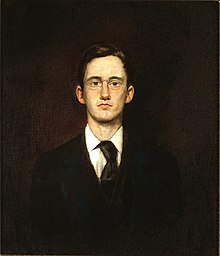
Self-portrait, 1890, oil on window shade, 14 x 11 7/8 inches, Delaware Art Museum, Gift of Helen Farr Sloan, 1970. A young human being instruction himself to oil paint from a book, Sloan painted on whatever was bachelor—in this case a window shade—and from the just model available, himself.
Training [edit]
Sloan's training consisted of his study and reproduction of works by painters such as Rembrandt, a few classes at various institutions, mentorship past Robert Henri, and his piece of work experience as an etcher and draughtsman. The high school that Sloan attended had a proficient art department, but it is not known whether he gained any training there. Sloan worked several jobs in draughtsmanship, etching, and commercial artwork before he attended the Pennsylvania Academy of the Fine Arts, where he studied briefly under Thomas Anshutz. The experience Sloan gathered from his various press jobs provided him with a certain corporeality of knowledge and immune room for him to explore and expand in his free time. Henri's mentorship was significant in Sloan's training because he encouraged him to paint more, and introduced him to the work of various artists, whose techniques, composition, and style Sloan studied. He sought boosted guidance from Ruskin'due south The Elements of Drawing and John Collier's A Manual of Oil Painting. Sloan believed his study and mentorship at the Pennsylvania University of the Fine Arts, besides as his early Philadelphia experiences, to be his "college education."
Early influences [edit]
At a young age, Sloan had been exposed to numerous books and reproductions through his uncle, Alexander Priestley, who held an extensive collection in his library. 1 major influence that he discovered was John Leech, an English caricaturist. When Sloan entered his position at The Philadelphia Press his newspaper drawings reflected the fashion of Leech, Charles Keene and George du Maurier. Simply by 1894 he had begun attracting attending with decorative illustrations in a new style related to the poster movement; these works combine the influences of European artists of the late nineteenth and early twentieth century, including Walter Crane, and reveal Sloan's study of Botticelli and Japanese prints.[27]
Sloan's early paintings may have been influenced by Thomas Eakins as a result of his time studying nether Anshutz. In 1893, Sloan and Glackens became regulars at a weekly "open firm" at Henri'due south studio, where he encouraged the young men to read Whitman and Emerson and led discussions of such books every bit George Moore'southward Modern Painting and William Morris Hunt's Talks on Art.[28] Henri believed in the demand to create a new, less genteel American art that spoke more immediately to the spirit of the age, an outlook that constitute set up adherents in Sloan and Glackens.
Style and the Ashcan School [edit]
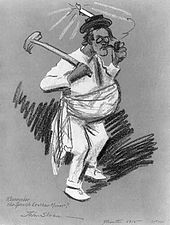
"Retrieve the Spanish leather miner?"
Self-extravaganza by John Sloan, 1915
Every bit someone who painted metropolis crowds and tenement rooms, shop girls and streetwalkers, charwomen and hairdressers, Sloan is i of the artists most closely identified with the Ashcan School. Yet it was a term Sloan despised.[29] He came to experience that information technology homogenized besides many different painters, concentrated viewers' attention on content rather than style, and presupposed a muckraking intent. His wariness was not misplaced: exhibitions of Ashcan fine art in recent decades often stress its documentary quality and importance every bit part of an historical tape, whereas Sloan felt that whatever artist worth anything had to exist appreciated for his skilled brushwork, color, and composition.
Unlike Henri, Sloan was not a facile painter and labored over his work, leading Henri to remark that "Sloan" was "the past participle of 'slow.'"[30] (When Glackens and Sloan were at The Philadelphia Inquirer, Glackens usually got the reportorial assignments because he was more adept than Sloan in making quick sketches.[half dozen]) His methodical approach towards sketching carried over to his painting. "Sloan's approach to making urban realist art was based on images seen and remembered (and sometimes written down) rather than sketched in the street, even though his autographic handling of paint and impress media conveys the await of a rapid cartoon. The effect is conceptual rather than perceptual, which Sloan denigrated as "eyesight painting."[31] This was a major characteristic of his style, consistent with the Ashcan School'southward goal of presenting a subject to the viewer with all the immediacy of a snapshot.
Sloan tended to observe metropolis dwellers interacting in an intimate setting. A student of his wrote, he "concerned himself with what we call genre: street scenes, eating place life, paintings of saloons, ferry boats, roof tops, back yards, and and then on through a whole catalogue of commonplace subjects."[32] Similar Edward Hopper, Sloan oft used the perspective of the window in his painting, in order to proceeds a tight focus, but likewise to observe his subject undetected. He wrote in his diary, in 1911; "I am in the addiction of watching equally of human life I can meet nearly my windows, but I do it and then that I am not observed at it ... No insult to the people y'all are watching to do so unseen."[33] Sloan's attention to isolated incidents within the urban environment recalls the narrative techniques used in the realist fiction and Hollywood films he enjoyed.[31]
Sloan was described every bit an "early on twentieth-century realist painter who embraced the principles of Socialism and placed his creative talents at the service of those beliefs."[34] Yet whenever Sloan was asked about the social context of his paintings or about his fervent Socialism, he said that his paintings were made with "sympathy, simply no social consciousness ... I was never interested in putting propaganda into my paintings, so information technology annoys me when fine art historians try to interpret my metropolis life pictures equally 'socially conscious.' I saw the everyday life of the people, and on the whole I picked out bits of joy in human life for my subject affair."[34]
In the late 1920s, but as the marketplace for his city pictures was finally reaching a point at which he might have made a comfy living, Sloan changed his technique and abased his characteristic urban subject area matter in favor of nudes and portraits. This independence was entirely typical of him, to the dismay of his dealer, Charles Kraushaar. Rejecting as superficial the spontaneous painterly technique of Manet and Hals—and also of Robert Henri and George Luks—he turned instead to the underpainting and glazing method used by quondam masters such equally Andrea Mantegna. It was an eccentric option. The resulting paintings, which often made unconventional use of superimposed hatchings to ascertain the forms, take never attained the popularity of his early on Ashcan works.[35]
Legacy [edit]

After the War a Medal and Perhaps a Job, anti-World War I political cartoon, 1914 (digitally restored)
Sloan's paintings are represented in almost all major American museums. Among his all-time-known works are Hairdresser's Window (1907) in the collection of the Wadsworth Atheneum, The Picnic Footing (1907) in the collection of the Whitney Museum of American Art, The Haymarket (1907) in the drove of the Brooklyn Museum, Yeats at Petitpas in the drove of the Corcoran Gallery of Art, McSorley's Bar (1912) in the collection of the Detroit Institute of Arts, The 'City' from Greenwich Village (1922) in the drove of the National Gallery of Art, and The White Style (1927) in the collection of the Philadelphia Museum of Art. In 1971, his painting Wake of the Ferry (1907) was reproduced on a U.South. postage stamp honoring Sloan.
His students included Peggy Bacon, Aaron Bohrod, Alexander Calder, Reginald Marsh, Barnett Newman, Minna Citron, and Norman Raeben. In 1939, he published a book of his teachings and aphorisms, Gist of Fine art, which remained in print for over sixty years.
In American Visions, the critic Robert Hughes praised Sloan'due south art for "an honest humaneness, a frank sympathy, a refusal to flatten its figures into stereotypes of course misery ... He saw his people every bit office of larger totality, the carnal and cozy torso of the city itself."[36] In American Painting from the Armory Evidence to the Depression, art historian Milton Brownish called Sloan "the outstanding figure of the Ash Can School."[37] To his friend, the painter John Butler Yeats, and to fine art critic Henry McBride, he was "an American Hogarth."[38]
The lobby of the U.s.a. Post Office in Bronxville, New York, features a mural by Sloan painted in 1939 and titled The Arrival of the First Post in Bronxville in 1846 commissioned past the Treasury Section of Fine Arts.[39] The postal service role and mural were listed on the National Register of Historic Places in 1988.[40]
See besides [edit]
- American realism
- Ashcan school
Notes [edit]
- ^ Brooks, p. 4.
- ^ Norma Roberts (ed.), The American Collections, Columbus, OH: Columbus Museum of Fine art, 1988, p. 48.
- ^ Loughery, pp. nine–10.
- ^ a b c Roberts, p. 48.
- ^ Loughery, p. fourteen.
- ^ a b c d St. John, Bruce. John Sloan in Philadelphia, 1888–1904, American Art Journal, Vol. 3, No. two. (Autumn 1971), pp. 80–87.
- ^ Bennard B. Perlman (ed.), introduction by Mrs. John Sloan, Revolutionaries of Realism: The Letters of John Sloan and Robert Henri, Princeton: Princeton University Printing, 1997, p. eighteen. ISBN 0-691-04413-9
- ^ Loughery, pp. 49–50.
- ^ Brooks, p. 57.
- ^ Loughery, p. 84.
- ^ Loughery, pp. 94–95.
- ^ Brooks, p. 86.
- ^ Loughery, p. 146.
- ^ Loughery, p. 177.
- ^ Loughery, p. 281.
- ^ Grant Holcomb, John Sloan and 'McSorley'due south Wonderful Saloon', American Art Journal, Vol. 15, No. ii. (Leap, 1983), pp. 4–xx.
- ^ Loughery, p. 186.
- ^ Loughery, p. 191.
- ^ Loughery, p. 192.
- ^ Loughery, pp. 202–205.
- ^ Loughery, pp. 224–225.
- ^ Notes From The 8: Robert Henri, John Sloan, William Glackens, Ernest Lawson, Maurice Pendergast, George B. Luks, Everett Shinn, and Arthur B. Davies, the Brooklyn Museum (exhibition catalogue), Nov 24, 1943-January sixteen, 1944.
- ^ Brooks, p. 160.
- ^ Holcomb, Grant (May 1978). "John Sloan in Santa Fe". The American Art Journal. x (i): 52. doi:10.2307/1594108. JSTOR 1594108.
- ^ a b Brooks, p. 170.
- ^ Loughery, p. 328.
- ^ Loughery, p. 30.
- ^ Loughery, pp. 32–35.
- ^ Brooks, p. 79.
- ^ Brooks, p.20.
- ^ a b Rebecca Zurier, "Picturing the City: Urban Vision and the Ashcan School", Ahmanson-Murphy Fine Arts Books, Published 9/half dozen/2006, Us – University Presses of California, Columbia and Princeton, CA.
- ^ Aaron Bohrod, "On John Sloan", College Fine art Journal, Vol. 10, No. 1. (Autumn, 1950), pp. iii–9.
- ^ Brooks, p. 63.
- ^ a b Hills, p. 157.
- ^ Loughery, p. 296.
- ^ Robert Hughes, American Visions: The Epic History of Art in America, New York: Knopf, 1994, p. 327.
- ^ Milton Brown, American Painting from the Arsenal Evidence to the Depression, Princeton: Princeton University Printing, 1955, p. 20.
- ^ Loughery, pp. 149, 215.
- ^ Larry Eastward. Gobrecht (November 1986). "National Register of Celebrated Places Registration: Bronxville Post Office". New York State Part of Parks, Recreation and Historic Preservation. Archived from the original on 2012-10-15. Retrieved 2010-ten-01 . Come across besides: "Accompanying five photos". Archived from the original on 2012-09-22.
- ^ "National Annals Information System". National Register of Historic Places. National Park Service. March xiii, 2009.
Sources [edit]
- Brooks, Van Wyck. John Sloan: a Painter's Life. New York: Eastward.P. Dutton & Co, 1955.
- Hills, Patricia, "John Sloan's Images of Working-Class Women: A Case Study of the Roles and Interrelationships of Politics, Personality, and Patrons in the Development of Sloan'due south Art, 1905–16", Prospects 5 (1980): 157–96. Cambridge University Press.
- Loughery, John. John Sloan: Painter and Rebel . New York: Henry Holt, 1995. ISBN 0-8050-5221-6
Further reading [edit]
- Bergquist, Stephen A. (2020). "John Sloan and Angna Enters: Portraits of a Trip the light fantastic toe-Mime". Music in Art: International Periodical for Music Iconography. 45 (one–ii): 201–215. ISSN 1522-7464.
- Coco, Janice M. John Sloan'southward Women: A Psychoanalysis of Vision. Newark: University of Delaware Press, 2004. ISBN 0-87413-866-3.
- Hughes, John. Excerpt from American Visions: The Ballsy History of Art in America.
- Hunter, Sam. Modern American Painting and Sculpture. New York: Dell, 1959.
- Kennedy, Elizabeth (ed.) The Eight and American Modernisms. Chicago: University of Chicago Press, 2009.
- Perlman, Bennard B (editor), introduction past Mrs. John Sloan. Revolutionaries of Realism: The Letters of John Sloan and Robert Henri. Princeton, New Jersey: Princeton University Press, 1997. ISBN 0-691-04413-ix.
- Leeds, Valerie Ann. The World of John Sloan. Orlando, Florida: Mennello Museum of American Art, 2009. ISBN 978-0-9668799-2-vi
- St. John, Bruce (ed.). John Sloan'southward New York Scene: From the Diaries, Notes, and Correspondence, 1906-1913. New York: Harper & Row, 1965.
- Zurier, Rebecca. Fine art for "The Masses": A Radical Magazine and Its Graphics, 1911-1917. Philadelphia: Temple University Press, 1988.
- Weinberg, H Barbara (2009). American impressionism and realism . New York: The Metropolitan Museum of Fine art. (see index)
External links [edit]
- Sloan'south Cats
- John Sloan at Artcyclopedia
- John Sloan at ArtNet.com
- John Sloan at AskART.com
- Seeing the Urban center: Sloan's New York, Delaware Fine art Museum
- John Sloan at New Mexico Museum of Art
- John Sloan - Spectator Of Life on YouTube
- Works by John Sloan at Project Gutenberg
- Works by or nearly John Sloan at Net Archive
Source: https://en.wikipedia.org/wiki/John_Sloan
0 Response to "The Art Students League of New York Lobby Phone Booth"
Postar um comentário